
Rugged Armor Phone Case Guide 2026
Is a rugged armor phone case worth it? Discover how military-grade materials and smart design protect your phone from drops, dust, and daily damage.
 Editorial
Think of a standard phone case like a pair of everyday sneakers. They’re comfortable, look good, and handle a casual walk in the park just fine. But a rugged armor phone case? That’s a pair of steel-toed work boots. Their job isn’t to be stylish—it’s to protect you when a toolbox gets dropped, no matter what.
A rugged armor case is built from the ground up for one mission: total device survival. It’s engineered to shield your phone from severe drops, hard impacts, and the grit of the real world.
Why Maximum Protection Isn't Overkill Anymore
It's easy to dismiss heavy-duty cases as something only extreme adventurers need. But with flagship phones now costing well over a thousand dollars—and screen repairs hitting several hundred—that mindset is changing fast. A serious case is no longer a niche accessory; it's a smart investment.
This shift is huge. The global market for protective phone cases hit nearly USD 25.97 billion in 2024 and is expected to climb to USD 39.26 billion by 2033. That growth tells a clear story: people are tired of paying for expensive repairs and see a high-quality case as an essential part of owning a modern smartphone. You can see more details on this trend by checking out the latest phone case industry growth data.
Who Really Needs a Rugged Armor Case?
While anyone can appreciate the peace of mind, some people’s daily lives practically demand this level of protection. If your phone is constantly in the line of fire, a rugged case is non-negotiable.
- Professionals in Tough Environments: Think construction workers, mechanics, or field engineers. Their phones face daily threats from concrete floors, dust, and accidental drops from ladders.
- Outdoor Adventurers: For hikers, climbers, and campers, a phone is a lifeline. A rugged case ensures it survives a fall onto a rocky trail or a tumble in the dirt.
- Parents with Young Children: Let’s be honest, kids are the ultimate drop-testers. A rugged case is the only thing standing between a toddler and a shattered screen.
The entire philosophy behind a rugged case is proactive defense. It’s built on the assumption that a catastrophic drop will happen, and it makes sure your phone is ready for it.
Before we dive deeper, let's get a clear picture of how these cases stack up against the more common, slimmer options.
Rugged Armor Case vs Standard Case at a Glance
This table breaks down the key differences, showing you exactly what you gain when you opt for maximum protection.
| Feature | Standard Phone Case | Rugged Armor Phone Case |
|---|---|---|
| Drop Protection | Basic (3-5 feet) | Advanced (8-15+ feet) |
| Material | Single-layer (TPU/PC) | Multi-layer (TPU, PC, foam) |
| Shock Absorption | Minimal | Reinforced corners, air pockets |
| Screen Protection | Raised lip | Deep bezels, often with protector |
| Dust/Debris | Minimal coverage | Port covers, sealed design |
| Size & Bulk | Slim and lightweight | Thicker and heavier |
| Ideal User | Office/casual use | Active/demanding environments |
As you can see, a rugged case is in a completely different league when it comes to keeping your device safe.
The Foldable Phone Challenge
Now, let's talk about foldable phones. All that incredible folding technology introduces a massive weak point that most cases completely ignore: the hinge. A drop that might just scuff a normal phone could spell disaster for a foldable's intricate moving parts.
This is where a one-size-fits-all approach completely fails. A proper rugged case for a foldable device can't just be a thick slab of plastic. It needs specialized hinge coverage that protects the mechanism without getting in the way of opening and closing the phone. It’s a tough engineering puzzle, balancing fortress-like durability with the unique functionality that makes a foldable special.
The Anatomy of Ultimate Phone Protection
A rugged armor case isn't just a thick slab of plastic; it’s an engineered system. Think of it like a knight’s suit of armor—a hard outer layer deflects the initial blow, while a softer layer underneath absorbs the force to protect what's inside. The exact same principle is what makes a rugged case so incredibly effective.
The real magic is in its multi-layer construction. Most top-tier designs use a two-part system that creates a powerful defensive synergy against drops.
The Dynamic Duo of Defense
The outer shell is almost always made from polycarbonate (PC), a rigid, shatter-resistant plastic. Its job is to be the first line of defense, taking the brunt of direct hits and resisting sharp punctures. It’s the tough exterior that greets the pavement first.
Beneath that hard shell sits a soft inner core, usually crafted from Thermoplastic Polyurethane (TPU). This flexible, rubber-like material is a champion of shock absorption. When the phone hits the ground, the TPU layer compresses and disperses the shockwave, stopping that destructive energy from ever reaching the delicate electronics inside.
The combination of a hard exterior and a soft interior is the foundational concept behind elite shock absorption. One material deflects, the other absorbs—ensuring impact forces are neutralized before they can cause damage.
This simple infographic breaks down the core protective functions of a rugged case against the most common daily threats.
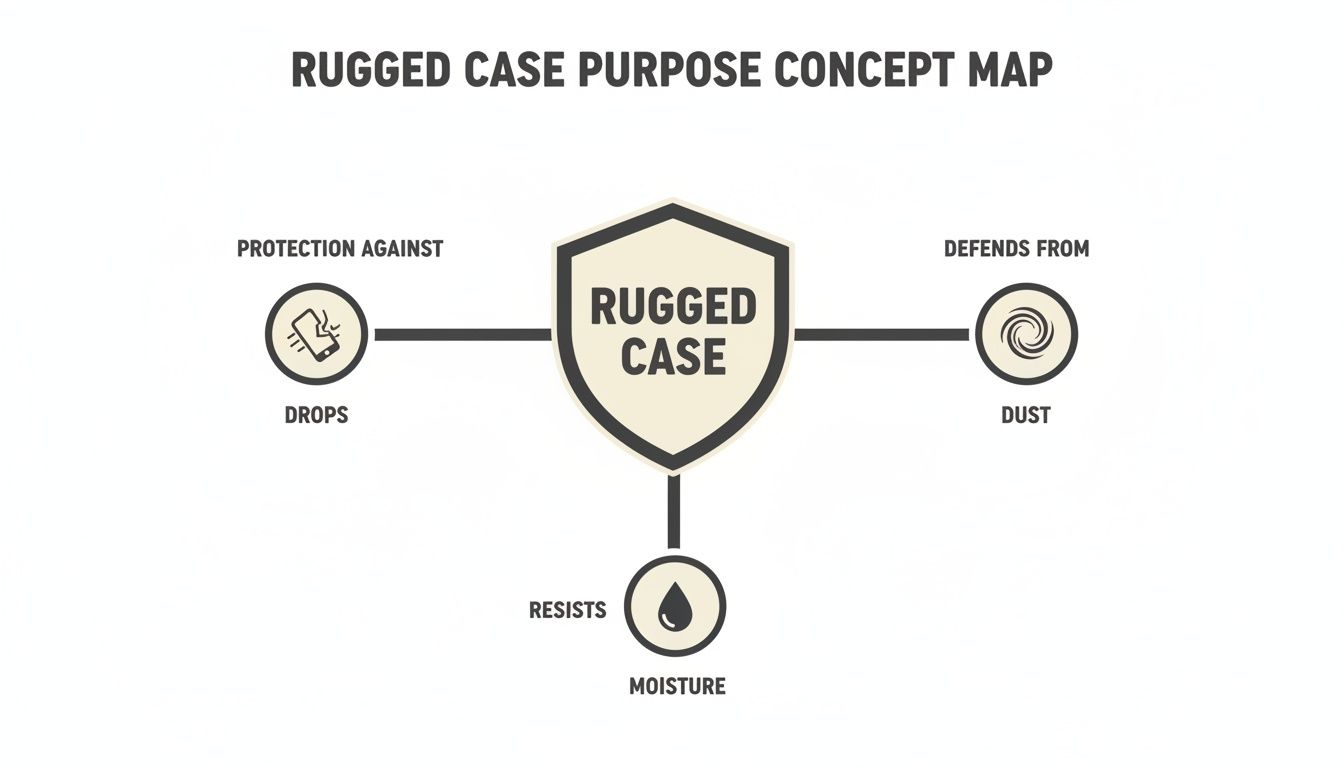
As the visual shows, a rugged armor case is designed as a complete shield against physical drops, invasive dust, and even incidental moisture. But this multi-layered approach is just the beginning. Several other design elements are crucial for providing true, 360-degree safety.
Beyond the Core Layers
Real protection is found in the details. The most effective rugged cases incorporate specific structural enhancements that target a phone’s weakest points. These aren't just afterthoughts; they are integral to the case's defensive capabilities.
- Reinforced Corners: Let's be honest, phones almost always land on a corner. High-quality rugged cases feature extra padding or even tiny air pockets in the corners, which act like a car’s crumple zones to absorb the most damaging forces.
- Raised Bezels: A deep lip or bezel around the screen and camera lenses is non-negotiable. This simple feature creates a buffer, ensuring your glass never makes direct contact with a flat surface during a fall.
- Tactile Grip: A case isn’t very protective if it’s slippery. Textured sides and smart, ergonomic shaping give you a secure hold, drastically reducing the chance of accidental drops in the first place.
- Port Covers: Dust, lint, and moisture are the silent killers of charging ports and speakers. Snug-fitting port covers seal these openings, blocking debris from getting inside and causing slow, expensive damage over time.
All these elements work together to form a complete defensive system. It's this thoughtful engineering—from the multi-layer core to the reinforced details—that elevates a rugged armor phone case from a simple accessory to essential survival gear for your device.
Decoding Military-Grade Protection Standards
You’ve seen "military-grade" slapped on everything from watches to backpacks, but when it comes to a rugged armor phone case, it’s a whole lot more than just a marketing buzzword. It actually points to a specific, verifiable standard of toughness—one that separates the genuinely protective gear from all the pretenders out there.
Think of it as a promise. This certification means your case has been put through a series of brutal, standardized trials and came out the other side intact.
The most common benchmark you'll run into is MIL-STD-810. This is a massive document created by the U.S. Department of Defense to make sure equipment can survive the brutal conditions of a battlefield. While the full standard covers everything from surviving extreme temperatures to resisting fungus, the part that really matters for our phones is the drop test.
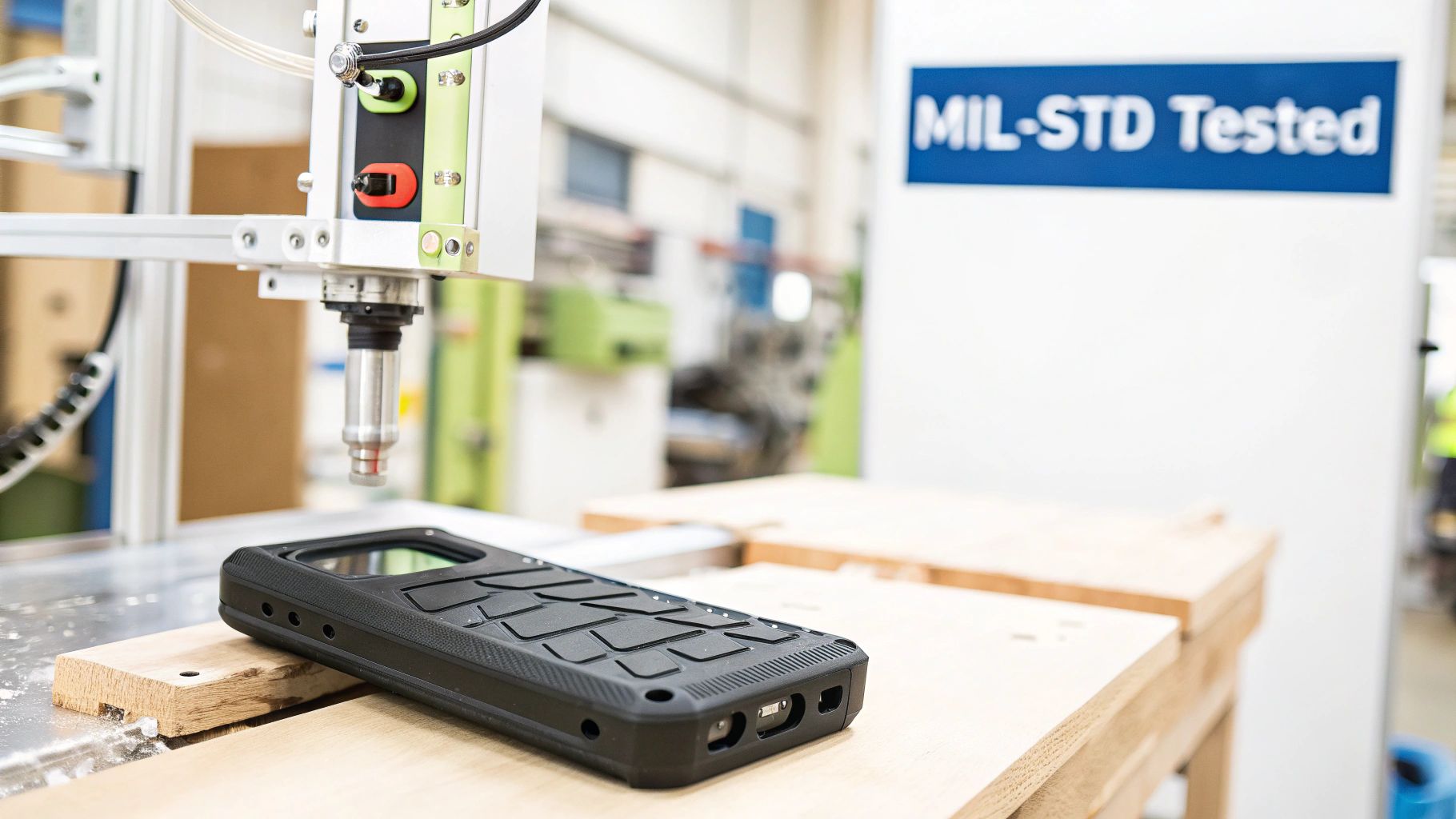
What the Drop Test Really Means
So, what does a "military-grade" drop test actually look like? It's not just a single drop onto a plush carpet. The procedure, specifically Method 516.6, is incredibly precise to ensure the results are consistent and prove a case's real-world strength.
A MIL-STD-810 certification isn't a magical shield against all damage, but it is a verifiable benchmark of resilience. It proves a case has been subjected to and survived a series of controlled, catastrophic impacts that would absolutely destroy an unprotected phone.
To earn that rating, a device inside the case has to survive a whole series of drops designed to hit its weakest points. The exact protocol can vary, but a common gauntlet includes:
- Multiple Drops: The device is typically dropped a whopping 26 times to test every single possible impact point.
- Varied Angles: This isn't just a flat drop. It includes falls flat on its face, back, and sides, plus every one of its corners and edges.
- Significant Height: The standard drop height is usually 4 feet (48 inches), which simulates a fall from your hand or a table onto a hard floor.
- Unforgiving Surface: The landing zone is often 2-inch-thick plywood laid over concrete—a surface with absolutely zero forgiveness.
Getting through this torture test means the phone inside must still be fully functional. That’s why seeing a MIL-STD certification is such a big deal—it’s tangible proof of how a case performs under serious stress. It confirms the case can handle the repeated, accidental drops that life inevitably throws its way.
As you look at your options, it really helps to get what these standards mean. You can learn more about military-grade case designs in our article and see how this intense testing translates to protecting today's advanced phones. With this knowledge, you can see past the vague claims and pick out a rugged armor phone case that delivers proven, battle-tested toughness.
Why Foldable Phones Need Specialized Protection
Let’s be honest, standard smartphones are basically solid slabs of glass and metal. Protecting them is a pretty straightforward engineering puzzle. But foldable phones? They're a completely different animal. Their greatest strength—the ability to fold—is also their greatest weakness, and that mechanical complexity makes traditional case designs totally obsolete.
The hinge is the heart and soul of a foldable, but it's also a delicate, exposed mechanism. A single drop on this critical point can lead to misalignment, screen damage, or a complete failure of the folding action. Your average case offers zero protection for this area, leaving the most expensive and intricate part of your device completely vulnerable.
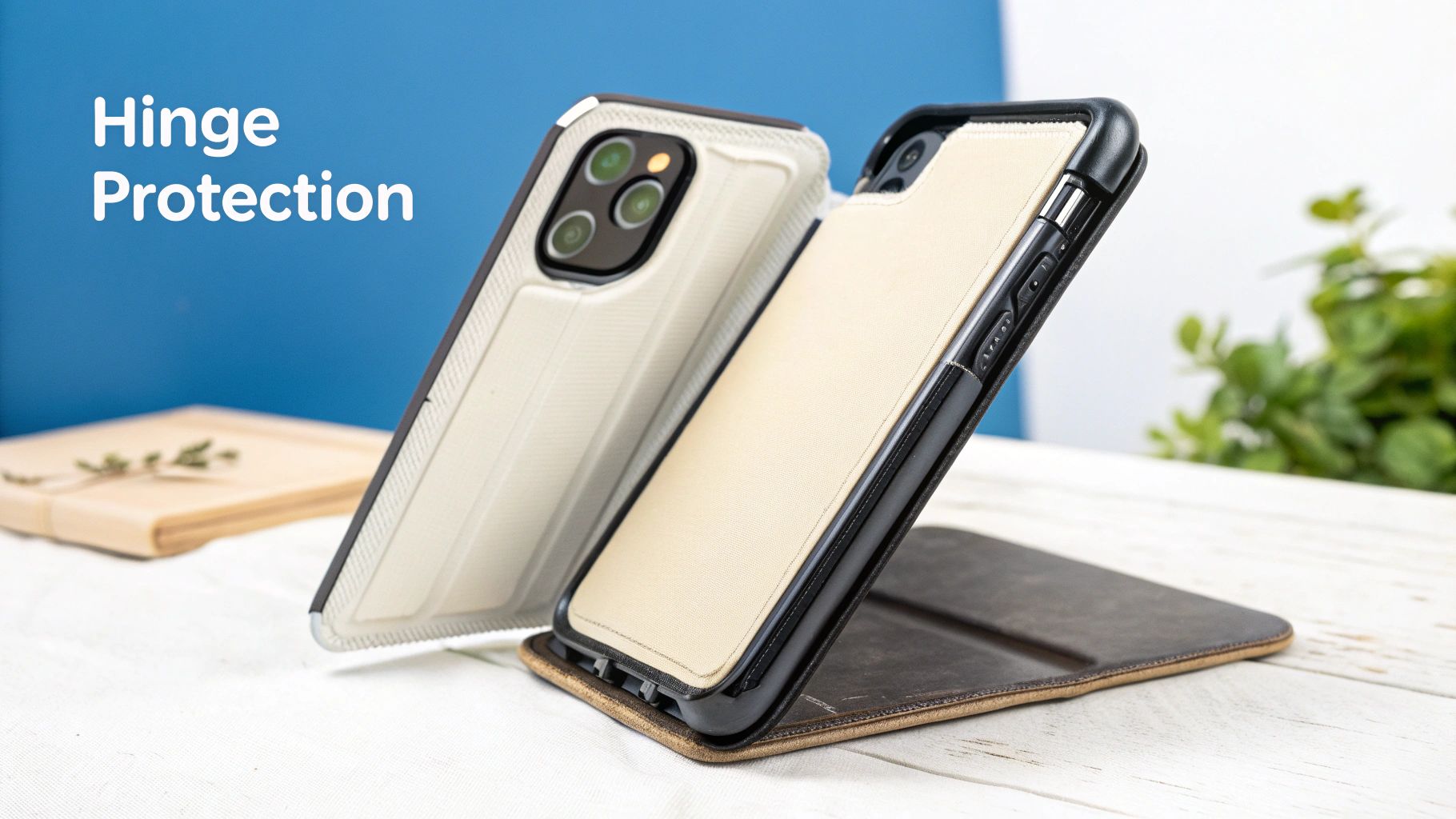
This is precisely why a specialized rugged armor phone case isn't just an "option" for foldable owners—it's a necessity. These cases are purpose-built to address the unique anatomy of a folding device. They move way beyond simple drop protection to offer holistic structural security.
The Non-Negotiable Hinge Guard
The defining feature of a proper foldable case is its dedicated hinge protection. This isn't just a slap-on piece of plastic; it's a carefully engineered component designed to shield the spine of the phone from direct impacts without getting in the way. Think of it as armor for your phone's most critical joint.
Effective hinge guards come in a few clever forms:
- Full Spine Coverage: This design gives you a solid, continuous shield that covers the entire hinge when the phone is closed, providing maximum impact resistance.
- Sliding Mechanisms: Some cases use an articulating cover that slides smoothly into place as you shut the device, offering robust protection that vanishes when the phone is open.
- Semi-Automatic Designs: These smart mechanisms often use springs to automatically extend and retract the hinge cover as you open and close your phone.
No matter the specific design, the goal is always the same: turn a major vulnerability into a well-defended fortress. This single feature is what separates a generic case from one that truly understands what a foldable needs. You can discover more about how specialized protection is built for foldable phones in our detailed guide.
Precision Engineering For A Perfect Fit
Beyond just guarding the hinge, a rugged case for a foldable must be a two-piece design that fits with microscopic precision. An ill-fitting case can add stress to the hinge, interfere with the folding motion, or worse, pop right off during a drop. This requires a level of engineering far beyond what's needed for a standard phone.
The market has definitely woken up to this need for superior defense. Hybrid and rugged protective cases are among the industry's fastest-growing segments, a trend pushed by professionals in construction and fieldwork who need military-grade safety. For owners of premium foldable devices, the market's focus on rugged armor cases with advanced features directly addresses their need for dependable protection that holds up in the real world.
For a foldable phone, a rugged armor case isn’t just about surviving drops. It's about preserving the core functionality that makes the device special in the first place—its ability to seamlessly fold and unfold, time after time.
Finally, a well-made rugged case has to deliver this high level of protection without compromising on modern features. It must be fully compatible with wireless charging and NFC payments, ensuring that you never have to choose between keeping your phone safe and actually using it conveniently.
How to Choose the Right Rugged Armor Case
Picking a rugged armor case is more than a simple purchase; it’s an investment in your phone's survival. With a flood of options all screaming about "ultimate protection," it's easy to get lost. The key is to cut through the marketing noise and focus on the features that actually keep your device safe.
Let's break down what really matters. A systematic approach helps you find a case that nails the balance between tank-like toughness, everyday usability, and your specific needs.
First, check the fundamentals of its construction. When you're learning how to choose the right rugged armor case, you should assess its durability, similar to choosing a reliable hiking water bottle—it needs to be tough but not impractical. Look for cases built with a multi-layer design, typically a hard polycarbonate outer shell fused with a shock-absorbing TPU interior. This combo is the gold standard for drop defense.
But don't just take a brand's word for it. You need proof.
Verify Protection Ratings and Fit
The first thing you should look for is a MIL-STD-810G or 810H certification. This isn't just a fancy label; it's a military-grade rating that proves the case has survived a battery of standardized, tough-as-nails drop tests. It’s the single most reliable sign of real-world resilience and separates the truly tough cases from the ones that just look the part.
Next up is the fit. A rugged case is completely useless if it’s loose, wiggles around, or gets in the way of using your phone. The cutouts for your charging port, speakers, and cameras need to be dead-on perfect. The buttons should feel clicky and responsive, not mushy or difficult to press.
A great rugged case feels like a natural extension of your phone, not a clunky prison. It should enhance your grip and confidence without sacrificing the core user experience.
Pay close attention to the ergonomics, too. What good is a case with amazing drop protection if its slick surface makes you more likely to drop your phone in the first place? Look for textured grips, contoured edges, or any design element that makes the case feel secure in your hand.
Consider Practical Add-Ons and Real-World Feedback
Once you've nailed down the essentials—protection and fit—it’s time to think about the extras that match your lifestyle. Many rugged cases offer a lot more than just pure defense.
- Integrated Kickstands: A sturdy, built-in kickstand is a game-changer for watching videos or hopping on hands-free calls.
- Wallet or Card Holder Slots: Some cases cleverly hide slots for a credit card or ID, letting you ditch your bulky wallet.
- Accessory Compatibility: Make sure the case plays nice with your screen protector and supports wireless charging if you use it. Our guide on the top 5 protective features for every phone case dives deeper into these must-haves.
Finally, do your homework and read what actual users are saying. With online sales growing at a 7.21% CAGR through 2030, there’s a massive amount of customer feedback out there. Hunt for detailed reviews that talk about long-term durability, how the case held up after several months, and—most importantly—how it performed during an actual drop. This kind of firsthand intel is priceless when making your final call.
Frequently Asked Questions About Rugged Cases
Even after you've got a good handle on what a rugged armor phone case brings to the table, some practical questions always pop up. Let's tackle the most common concerns head-on, clearing up any final doubts so you can feel confident about how you protect your phone.
We’ll get into everything from day-to-day usability to keeping your case in top shape.
Will a Rugged Armor Case Make My Phone Too Bulky?
This is easily the number one worry, and it’s a fair one. Rugged cases are naturally thicker than your average slim case, but modern designs have come a long way. Engineers now focus on striking that perfect balance between rock-solid protection and a design you can actually live with, using advanced composite materials that add durability without piling on the grams.
Instead of thinking of it as strapping a brick to your phone, picture it as adding a smart, ergonomic shield. Keep an eye out for cases described as "rugged yet ergonomic," which usually means they have clever design touches like tapered edges and textured grips. These small details make a surprisingly big difference in how secure and manageable the phone feels in your hand.
For a foldable, a well-made rugged case is engineered with such precision that it adds this critical layer of defense without ever getting in the way of the folding mechanism. The goal is to protect, not obstruct.
Does a Rugged Case Interfere with Wireless Charging?
For the most part, no. The vast majority of high-quality rugged armor phone cases are built to be fully compatible with Qi wireless charging and NFC for things like mobile payments. Whether it works really comes down to the case's thickness and the materials used.
You typically only run into problems with extremely thick, over-the-top cases or those that have big metal plates on the back for kickstands or magnetic mounts, as metal is the enemy of wireless charging signals. Any reputable brand will clearly state "wireless charging compatible" in the product details, so it's easy to check before you buy.
Premium brands that focus on today's top flagship phones almost always design their cases to support these features. They know you want elite protection without having to give up the conveniences you use every day.
It's all about adding peace of mind, not taking away essential functions.
Is a Military-Grade Certification Really Important?
Yes, absolutely. It's one of the clearest signs that a case's durability has been put to the test. When you see a MIL-STD-810G or 810H certification, it means that case was sent to an independent lab and survived a series of specific, brutal conditions. The most important one for most of us is the drop test, where it's dropped repeatedly onto hard surfaces from different heights and angles.
Sure, a non-certified case might still be protective, but that certification gives you a standardized, verifiable benchmark for its toughness. It’s official proof that the design has held up under unforgiving, real-world scenarios.
This is especially critical for expensive devices like foldables, or for anyone whose phone lives in a demanding environment where a drop isn't a matter of "if," but "when."
How Do I Clean My Rugged Armor Case?
Keeping your case clean is simple, but it's key to making it last and look good. A little regular maintenance also ensures things like port covers and buttons keep working as they should.
Just follow these easy steps to get it looking fresh:
- Remove Your Phone: Always, always take your device out of the case first.
- Separate the Layers: If you have a multi-layer case, carefully pull the hard outer shell away from the soft inner layer.
- Wipe Down Surfaces: Grab a soft cloth, dampen it with a bit of mild soap and water, and wipe down every surface.
- Clean the Details: For stubborn grime in tight corners or around port covers, a soft-bristled brush (like an old toothbrush) works wonders.
- Dry Completely: Steer clear of harsh chemicals or abrasive cleaners, which can wreck the materials. Let all the parts air dry completely before putting it all back together and snapping your phone back in.
Ready to give your foldable phone the fortress-like protection it deserves? At FoldifyCase, we specialize in rugged armor cases engineered with precision hinge guards, MIL-STD drop ratings, and ergonomic designs. Don't leave your investment vulnerable. Explore our collection and find the perfect defense for your device today at https://www.foldifycase.com.
Shop FoldifyCase foldable phone cases
Precision cases for Galaxy Z Fold & Z Flip — full MagSafe, S-Pen ready, zero bulk.